Road Director Diaries: An Interview with NYC’s biggest race Director
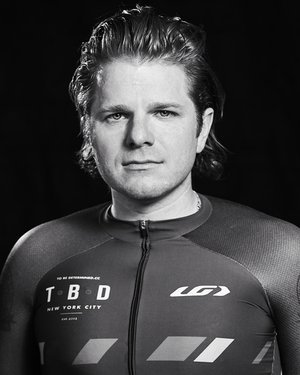
I recently had the opportunity to sit down with Tom Mains of Mainsport Event Timing and Management. Tom is a cornerstone of bike racing on the East Coast, with his timing company providing results at more than 160 events each year. Tom is also a racer, a leading race director in the New York City area, and President of the New Jersey Bicycling Association, giving him a unique perspective on the state of bike racing in the area.
We covered a lot of ground in the conversation, from the operational and financial challenges facing race directors to the critical importance of rider safety and park relationships, and how the cycling community can better recruit and retain the next generation of racers and organizers. In fact, we covered so much ground that we’re breaking this interview into two parts, with the second being published next week.
This interview was lightly edited for clarity and brevity.
A Conversation with Tom Mains, PART ONE:
Matthew Vandivort, TBD [MV]: You and I have known each other for years, Tom, and there is a lot that I don’t know about your background. We will get into some of that but I want to start with the present day: how many races are you involved in now? How many weekends a year are you doing something at a bike race?
Tom Mains [TM]: This year and the prior two years have been pretty steady on the number of events. I've been at—or my company has been at—about 165 events per year. When I say event, for example, a mountain bike national championship is five days, but that's just one event. So those 165 events are probably 220 or 240 or so event days. There are weekends where we've got six, seven, or eight events we're supporting in one weekend. On top of that, as far as race directing, I have 14 Prospect Park races, five or six Branch Brook races, and usually a couple of others, plus open race directing for CRCA. Last year was in the low to mid 20s for events that I either own or direct. With Floyd Bennett Field included, it's close to 40 events a year that I direct or run in full.
MV: Wow, that is a huge number. Does that number of events feel pretty maxed out to you or do you think there's more room to grow?
TM: It totally depends on finding the right venue and the right events. I can’t take on a Tour of Somerville scale event because the logistics are too great. And I can’t do 15 Grant’s Tombs. But if we find secure locations like Prospect Park, Central Park, or Branch Brook where we have a closed venue where it's easier to staff and manage logistics? I have more bandwidth for that kind of stuff. So it really just depends on what the event would be, but yes, there is room to do more.
MV: What keeps you motivated to keep such a rigorous schedule?
TM: I have a buddy I rode with for years and years, someone I'm accountable to now because otherwise I get busy. With him it's, "Okay, we're riding at 9.” Okay, I'm there at 9:00. There's usually three to six of us. And some rides are pretty freaking hard, so I'm actually getting pretty fit. It makes me very happy. A couple of years ago I got to the point where I was at some really big events and I'm coming home after a long day of doing the trailer, fence, and truss, and I'm exhausted, thinking, “Do I really want to keep doing this?” I thought about getting rid of some of the big events. I could do fewer events, make a little less money, but just have less stress and less hassle. I felt that way a couple of times. But then I started riding and lifting and getting fit again. In the last couple years I just feel like I'm on top of everything. I'm ahead of the game. And the only thing I changed was I got fit.
MV: I gotta say, as a racer, I am thankful to hear that. We joke a lot about the fact that if you decided to retire suddenly, that would be a big challenge for the local race community
TM: Well, it wouldn't be good short term, but everyone likes to think they’re more important than they actually are. Bike racing will survive if I go away. It'll just be a rough patch for a short while.
MV: That’s a good perspective, but I’m not so certain. I'm as nervous as I have ever been about the state of the scene. I've been working on this massive data analysis project that we’re publishing soon and some of the new rider trends are terrible. This year was hopefully an exceptionally bad year that we'll bounce back from next year, but the math looks really tough for the sport right now.
TM: Yeah, it is for sure challenging in some ways, but there is also a lot that can be done to improve the outlook, and I’m sure we’ll get into that.
MV: Let’s step back to what brought you here, I’d love to hear how you got to your current role in the sport - were you a race director first or did results come first?
TM: I'm going to go way back. I got into bike riding with my stepdad. He was a recreational cyclist. I started riding when I was about 11 or 12. And when I was a freshman in high school, I had to do a project for school. You had to do an adventure and write a paper about it. My adventure was riding my bike from Hamilton area in New Jersey down to the Shore to my grandparents house. So, that 50-mi ride for me was huge back then. I did that and then, you know, I just kept riding, and that progressed into working at a bike shop. Since then, I've touched most aspects of cycling. I actually have a professional mechanics license.
I've been a mechanic for the US national team at two world championships plus some other events, the 7-Up Pro team, and the Jelly Belly Pro team. I was a mechanic and driver for SRAM and Mavic Neutral Support. I've been on the board of directors at USA Cycling, on the Cyclocross Sport Commission, I'm an official and I’ve been the President of the New Jersey Bicycling Association(NJBA) for I think 23 years now. I've touched pretty much most aspects of cycling, so I bring a pretty broad experience to an event. I've been involved for a long time.
MV: That is quite an impressive set of palmares.
TM: And on the racing side, I started racing in high school and then got really serious when I got out of high school. There were years I was racing 80 to 100 days a year before I got into where I am now. I raced track, road, cyclocross, and mountain bike for a long time. The only things I haven't done are a BMX race or a gravel race, but cross is kind of the same thing.
MV: Are you racing now? You talked about building fitness back, do you have race ambitions?
TM: Yeah. Well, I have a little unfinished business on the track. I've actually been on the podium 13 times at nationals on the track, but I don't have a jersey. So, I would very much like to have a national champion jersey. But it is harder now. When I have staff and I'm at a race, I'll jump in when I can. This year I raced Cherry Blossom, Somerville, Harlem, Riverton. I'd like to do a little bit more next year. But one of my intentions is to go to Masters Track Nationals and actually get some training in and secure a couple of days where I can actually do the travel and do the race.
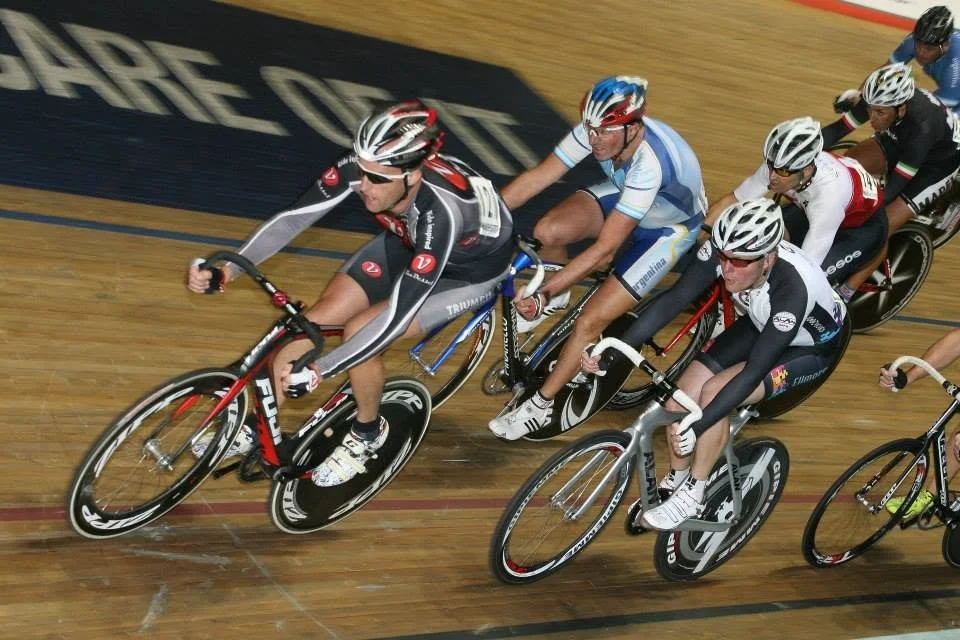
Tom in action at the Track World Championships.
MV: And in the spectrum of everything you do in the sport, is there an aspect of it you enjoy most?
TM: I think I'm one of the lucky people who likes what I do for a living, and it grew organically. Going back to whether I got into directing or timing first: I've been involved in cycling a long time and used to go to all the New Jersey Bike Association meetings. I wanted to get involved, so Jim Bernstein and I became friends, rode together for a couple years, and decided to try putting on a race. We founded the Kingwood Time Trial on Route 29 in Frenchtown, NJ in 2003. That was the first race I put on.
Back then it was pencil and paper—we didn't have timing equipment or cameras, just stopwatches. We did the race, made a couple dollars, gave back to the sport via a new event, and it worked well. We started developing a formula of using a controlled course so that we didn’t need any marshals out there since we didn’t have a club to provide that resource. We decided to do another one because time trials are pretty easy and people like them. After that, we realized all the manual writing was inefficient, and since Jim is really good with Excel, he started writing registration software. So we were in a good place for running registration.
Then we took over Branchbrook, which is a whole other story. The guy running it previously wasn't good for the sport. When we took it over we were paying a lot of money every week to have someone time our race, so we decided to buy a camera and do it ourselves. Of course to start we bought the wrong camera and totally screwed it up, but then bought a better one. It wasn't the level of equipment we have now, but with that we had registration and results, and local organizers asked us to time their races. From there, it started growing.
By around 2011 or 2012, I had accumulated a lot of gear—cones, tables, chairs, generators, and more. A friend out West who times races like USAC Nationals had a big trailer with a stage on it. I needed storage, so I decided to get a trailer, but realized that I could build a stage, set up a truss and sound system, and generate revenue with it while storing everything in the trailer. So I built the trailer, bought my first high-speed camera in 2012, and incorporated the timing company. From there, it grew from 50 events to 80, then 100, and now up to over 150 events a year.
MV: You talked about shifting to high-speed cameras. But you also rolled out timing chips in NYC. Have those worked as well as you hoped when you first introduced them?
TM: They have. The adoption regionwide has been a bit of a challenge, but they have worked well in New York City. The chip initiative started during COVID. I went to CRCA because I wanted to get chips embedded in this region. I told them that showing up at 4:00 AM in the morning with everyone checking in, signing in, and getting bibs was chaos. I suggested that since CRCA has a controlled membership, we embed chips into the membership itself. That way, there's no morning check-in required. Members line up at the start line, cross the line, the system reads the chip, and we print out the results showing who raced.
The board loved the idea because it eliminated the need for check-in volunteers. And in addition to streamlining registration it allowed us to provide lap times, sprint points, and remote sprint points. Instead of staffing the back side of Central Park to score a sprint point, we put a box on the ground for automated scoring. When I took over Prospect Park, I phased in the chips gradually rather than making them mandatory immediately, as managing chip rentals on-site in the morning would have been chaotic. But in Prospect Park with the KOM scoring it removed a layer of complexity. We used to have to staff the KOM with an official who had to count the number of laps and make sure he manually scored the KOM, which was tough to manage.
MV: Yeah, that sort of manual operation adds a real layer of complexity to running a bike race.
TM: Now, we will throw a timing box on the ground and it's automated, boom, done. We have accurate results, you get your lap times, all your points, and the results are much faster. I didn't want to be super heavy-handed and say you have to buy a chip or you can't race. So, if you don't care about the points, we still score you. It won’t be in the live results - it might be when I get home, you know, it takes time to go through the camera and find all the people, which we sometimes can’t get done at the venue on race morning.
I also have a buyback program. If you read the Bikereg page if you buy a chip and then get a job in Germany or grow to hate bike racing or get hurt, I'll buy the chip back from you minus a per race rental fee for use. So there's an out if someone needs it, you're not locked into this. Buying a chip is $75 and that’s the same cost as a tire, but this unlocks so much more with race results. So it's not an onerous thing, I don't think, and now you can look at lap times. You can compare with your buddies. You can compare development race lap times to the 123s and see how much better do I need to get to ride that field. So, I think we provide more of a service with the chips, too.
But I would like to see it more widely adopted. Right now, we have about 1300 or 1400 chips in circulation in the New York, New Jersey area. So, it's pretty good, but I'd like to see the whole region including Pennsylvania and more of New Jersey. But it's a little harder because everyone has to agree this is the system we use. But I think we're on the right path, it's just taking longer than I was hoping it would. At the same time, I think most people now understand the value of the chips, too.
MV: Shifting gears a little bit. 2026 road season's done. Any thoughts on how it played out overall?
TM: It's been up and down across the nation and region. Branchbrook was pretty well attended, and almost every Prospect race was up in attendance over last year. We had some challenges in Central Park. The bigger events, the experienced events as I like to call them, like Easton and Somerville, still had great numbers because people plan around those weekends for a cool, big event, whereas some of the smaller events may be suffering a little bit.
I think road cycling as a whole is still suffering, but we are fortunate in the NY metro area where we almost live in a cycling bubble. Even when things are bad, we still have it pretty good because there are so many people, and as long as we hang on to the parks and do the right things, we can have good racing. So we buck the trend a little bit nationwide. I was pretty pleased with what I saw this year. We have a long way to go, but it was better for my events.
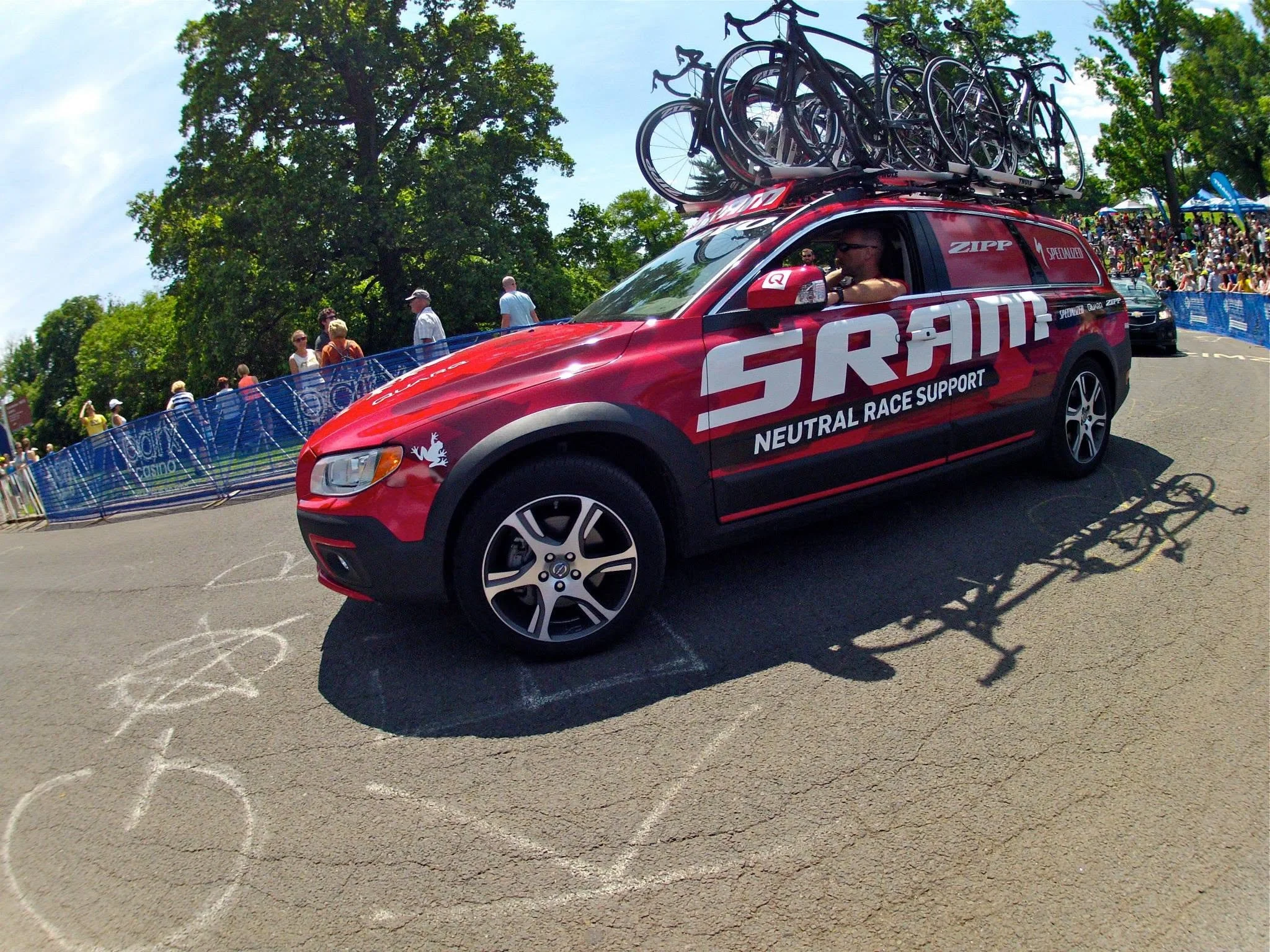
Tom behind the wheel of SRAM Neutral Support.
MV: When we spoke earlier this year, you mentioned that adding the Master's competitions had a good response. Are there any other changes you made this year that you thought were particularly successful?
TM: Most people don't know this, but I was going to make some wholesale changes to the Verge series this year because the numbers were pretty awful for certain fields last year. The Masters races averaged only 37 riders a race. The Cat 2/3 race wasn't bad—it was 50 or 60 riders. The women were stellar last year; they averaged like 34 or 35 a race, which was great. But the other fields were all smaller than we would like to see.
The Verge series, when Charlie ran it, was built as more of a development series. So instead of a Cat 1-2-3, it was a Cat 2-3 to give those 2’s and 3’s a chance to win some prize money, win races, and wear the leaders kits. Same thing with the Masters race: give the Masters their own race instead of being pulled out of a different race. Which I think is a good idea on paper, but having a Cat 5-only race excludes all the Cat 4s, and doing Cat 2/3 cut out the Cat 1s, a big part of the elite fields.
MV: When you need every dollar possible from registration, eliminating categories is a tough proposition, even if you are giving other categories unique opportunities?
TM: Right, so a couple years ago I added the 4s into the Cat 5 race, but at that point USA Cycling allowed you to voluntarily upgrade from 5 to 4, so there wasn't much of a difference. Now we are back to having to do 5 races to upgrade, but the 4s are still in there. I think some of them would like to have a slightly longer race, which I can't do given our schedule in the park, but I do want to give as many people an opportunity to race as I can. So we added the 55+ competition to the Masters field this year, which I think helped. The Masters numbers were much better this year. The women again really supported the series and it was great to see. We averaged 35 or 37 women a race, which is awesome.
MV: That's a great turnout.
TM: Yeah, I started that Women’s series four or five years ago, and I'm glad we did it and will continue. It's been great. But for the rest of the Series I was assessing whether to make some big changes given the 2025 numbers for other fields. I thought about allowing Cat 1s to race in the 2/3 field but not be scored in the points. I was considering a combined 3/4 and Masters race where the Cat 3/4s were just racing for experience and upgrade points with no jerseys awarded, just to give Cat 4s a longer distance and more opportunities to race alongside Masters, Cat 3s, and a handful of 1s and 2s.
MV: Interesting, I had no idea that was up for consideration.
TM: I think it was a reasonable change to make, but it was also a big change and there would have been pushback. So I just implemented the 55+ change this year, and I was very pleased with the results. Attendance across all races was up. Next year will tell if that trend continues, but I'm trying to give the most people the opportunity to race within the limited number of races we can host in the city.
I don't want to just throw 150 people into a race and have it be chaotic. I want to provide a good experience for everybody—streamline things, keep the admin stuff quick, and make it a fun race while giving as many people a chance to compete as possible. We can't add fields—Prospect is just 3.4 miles around so we are capped. And we can't run later in the day, so we're restricted in what we can do. It's just a matter of finding the right mix of what works. I thought this year was pretty good. The Lucarelli & Castaldi series was a little better attended as it always has been, since Cat 1s and other riders can enter. I don't know if I'm going to make changes to either Series yet, but I will review everything over the offseason and welcome suggestions from riders.
MV: The KOM and sprint competitions. CRCA started to do sprint competitions in Central Park as well, but those have always been a fun aspect of the Prospect Park Series. Do you think those are generally working well in Prospect Park?
TM: We don't have any complaints about them. The only issues arise when people forget to wear their chips. At the KOM, it's strictly a chip reader, so you're out of luck without one. If someone made an honest mistake—like crashing their bike the week before and leaving the chip on it—I've made occasional exceptions for sprints. But if someone is a habitual offender and forgets their chip, they won't get points because it’s too disruptive to process. Overall, the KOM and Sprint points work well. And as a general matter we have a great crew of officials that manage the races in Prospect extremely well, which makes my job much easier on hectic race days. It is a great team.
MV: What about the relationship with the Parks Department? They have speed limit boards in Central Park and rumble strips in Prospect Park. What is the relationship like for Prospect Park specifically?
TM: The relationship is good. We're very careful to keep things safe for park users and take care of the park. They like having us there, and we play by the rules. We have to continue making safety a priority for everyone in the park.
A lot of the park changes aren't even up to the Parks Department because the city owns the roads inside the park. When the city runs pilot programs, like adding jogger lanes on both sides of the road, the Parks Department doesn't have much say. They were nervous about it, too, especially regarding heavy vehicles like dump trucks or garbage trucks driving through crowded lanes with walkers on both sides. They aren't making changes to spite us; they have to prioritize safety. So things like the rumble strips are a slight concern, but those should be manageable.
MV: I've ridden on it a few times. I think it will be fine in the dry, though you get a slight rattle effect going over it. I haven’t tested it in the wet.
TM: If they had gouged the pavement or put down deep pavement rumble strips, we might have been in trouble. But again, it wasn't a park decision. There is a working group in the park consisting of runners and cyclists, and we have representation on that board to maintain constructive dialogue with the Alliance. Our park representative has been very happy with us which is important. That relationship is important. And they mention that our races are generally better staffed and run than many other events in the park. We want to maintain that standard and continue making improvements where we can.
MV: When you think about the long-term sustainability of Prospect Park racing—whether it's marshalling, safety, or cost pressures like insurance fees—do you have big areas of concern?
TM: First and foremost, it comes down to safety. Keeping the community and riders safe while maintaining a good relationship with the park is our biggest priority. Cost is also a major factor. Over the five or six years I've run these races, costs have risen every year. I've tried to raise more sponsorship or absorb expenses, but Porta Johns, ambulances, marshals, and insurance all cost more every single year. And we can't just keep raising registration prices indefinitely. Many people don't realize the budget required to put on a race. For example I need 12-13 riders to sign up just to cover the cost of Porta Johns. When you add six motorcycle officials, 23 marshals, three officials, reg staff, prize lists, and insurance/park fees, expenses add up quickly.
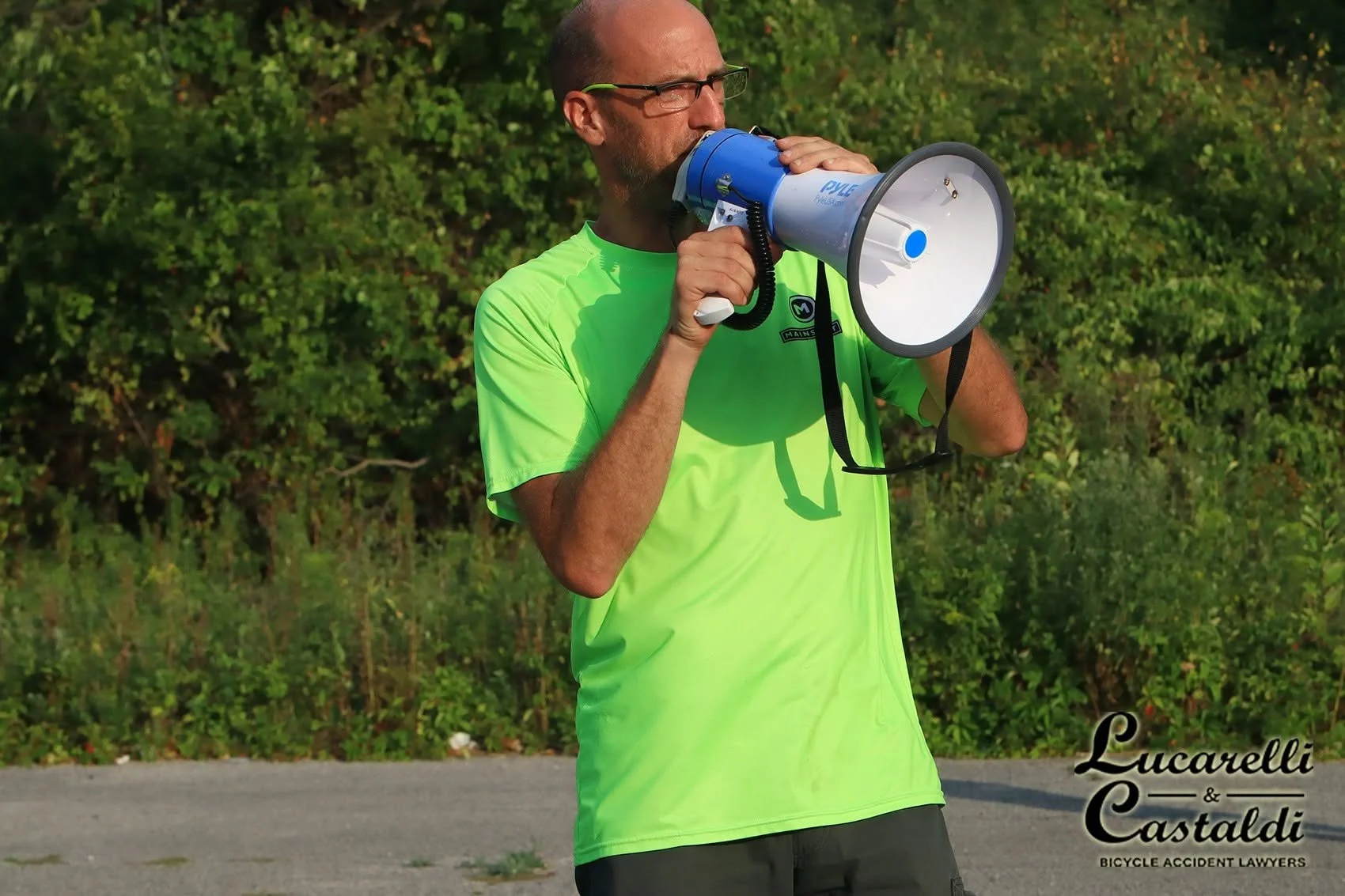
Tom race directing at Floyd Bennett Field, which we discuss in detail in part two.
MV: You mentioned not having space for additional fields in Prospect Park, but at the same time it is nice that Prospect Park only requires 23 marshals compared to something like 60 for Central Park, where the cost structure is much higher.
TM: It is. CRCA are fortunate to run five races with larger fields; otherwise, making the math work would be very difficult given the cost structure. But almost everything we want to do with races comes with cost challenges. When we started the women's race, we were concerned because Prospect Park races had always started later in the morning compared to Central Park. Central Park starts at 5:30 AM but Prospect had never been earlier than 6:00 AM. But the only way to run a Women’s field was to start earlier. So I asked the marshals if we could extend the morning slightly for extra pay. Then we moved the start to 5:45 AM, which created a dedicated slot for the women's field. The motorcycle marshals confirmed it was safe, and the setup has worked out very well, and other fields accepted the earlier start time.
I consulted with Women racers before launching the series to ensure the format would succeed. And there have been some changes from rider feedback. In the first year, having two sprints and two QOM’s per race led to constant sprinting, whereas cutting down to one sprint across a short series meant the competition ended too quickly - if one rider won two sprints the competition could effectively be over. So we moved to a rotating schedule—alternating between two sprints/one QOM and one sprint/two QOMs—to spread out nine sprint opportunities and improve the overall rider experience.
MV: How has it been managing schedule conflicts with other races as of late?
TM: We really try hard to play nice with everybody. It is always a juggling act to work conflicts out with other promoters. And unfortunately Central Park largely tells CRCA what dates they can use, so they do not have as much flexibility and sometimes we have unfortunate conflicts. When there are conflicts we will try to do what is best for the community. So if we have a Branch Brook that overlaps with CRCA, we typically won’t run a Women’s field at Branch Brook because we don’t want to split the Women’s racers across two events and wind up with two small fields.
So we really work to handle conflicts like that. We’re definitely not hitting copy paste on the schedule, it is a process to sort out every year. We’re also reviewing everything we’re offering on field structures, but even so we can get surprised. This is going back 15-years but there was one season where we had a bunch of racers age out of the 40+ field into the 55+ field and so all the sudden our 55+ category quadrupled in size and we had to make tweaks to accommodate it.
Part two coming next week…
Stay tuned next week for part two of this interview where we’ll dive into the core of the conversation including sponsorship, how the sport is currently missing the next generation of leadership, and what the community can do to support bike racing.