State of the Sport: NYC Bike Racing in 2026
Longtime readers of the TBD Journal will be familiar with our State of the Sport series and its examination of bike racing trends. Given the recent community discussions regarding registration trends for the CRCA Grant’s Tomb Criterium, the timing feels appropriate for a new entry in the series that takes a look at how the 2026 road season is playing out in New York City.
For those unfamiliar, the State of the Sport has historically focused heavily on the CRCA calendar, in part because TBD members have served as board members and race directors for many of these events. And this season’s CRCA calendar takes place against the backdrop of significant changes at the Club and its races. This includes shifting away from USAC-based permitting and opening the CRCA Club Series to ‘per race’ entries for the first time.
Spoiler alert: recognizing that USAC-permitting is a hot button topic, nothing in the data we reviewed quantifies exactly how much of an impact this change, or other factors related to CRCA, are having on turnout. Rather, we are primarily focused on the outcomes of permitting and everything else that goes into bike races. Quite simply: what do registration trends look like for various NYC road races?
Grant’s Tomb Criterium
Let's start with the race that instigated this analysis. The CRCA Grant’s Tomb Criterium is an event that I have both organized and confessed my love for as one of the few truly unique NYC races. I stepped back from the event after the 2019 race, which surpassed 800 registrants for a single day of racing. Since then, a lot has changed. Broader post-COVID trends have undoubtedly impaired participation, while a shift to a mid-summer date has had an unknown impact (good or bad).
Unfortunately, the 2026 edition of the Grant’s Tomb Criterium was by far the smallest on record. Total Bikereg.com registration sat at fewer than 200 riders, down almost 50% compared to 2025, which had been the smallest recorded turnout until now.A 65% decline in race registrations over two years is obviously discouraging for a race that for all its unique attributes, also features significant overhead and time investment for the CRCA to host the race.
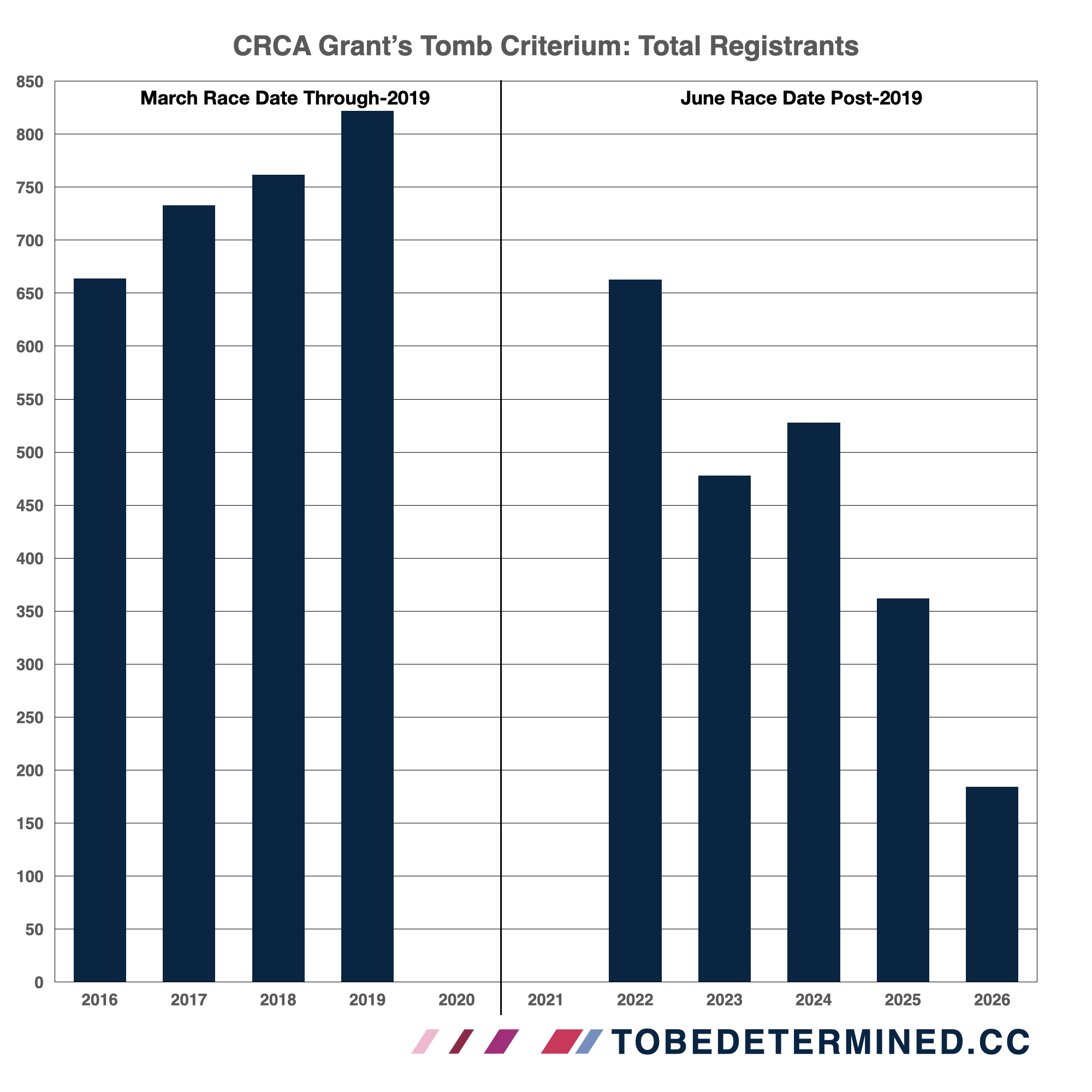
Ultimately, race organizers ultimately survive on turnout. As such, it is difficult to paint the 2026 edition as a sustainable event or a financial success. However, there are known factors that contributed to this dire turnout. There was a Prospect Park race the same morning (with 110 registrants). The weather forecast looked terrible for the week leading into the race, only for many of the morning fields to escape the rain. And the race date was also announced late as part of a belated marketing campaign that only seemed to kick off a few days before the event. The first email I received about Grant’s Tomb arrived on June 23, four days before the race and two weeks after I had already scheduled an out-of-town trip that forced me to miss it. How much of the 2026 attendance decline was a function of weather, marketing, or the permitting changes is impossible to prove. The bottom line is that this was a brutal year for the event, but hopefully, it will bounce back in 2027.
Over time, the State of the Sport has also examined Women’s field turnout. For Grant’s Tomb, the Women’s field turnout has often mirrored total turnout, declining 31% in 2025 and another 44% in 2026. However, that 44% decline is actually slightly better than the total 2026 registration decline of 49%. As a result, Women’s fields represented 18.5% of this year’s Bikereg.com registration. While we’d all like Women’s fields to represent a larger percentage of turnout, it is somewhat encouraging that this year was only slightly below the 18.8% peak from 2016. Perhaps this is sugarcoating the broader attendance declines, but again, this is an area for potential improvement in 2027.
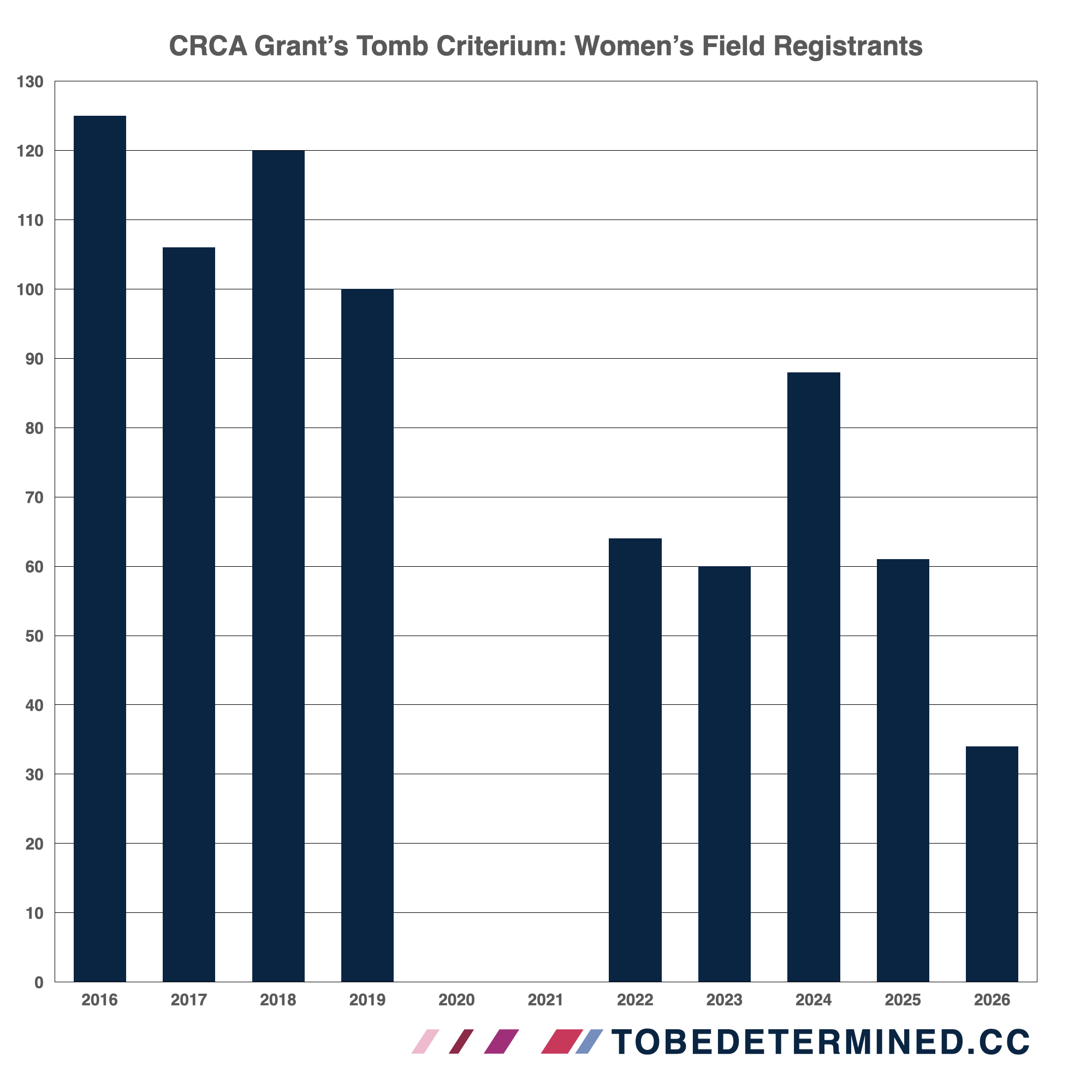
Source: Bikereg.com advanced registration data. Does not include day of registration. Excludes Junior fields 2022-2026.
CRCA Mengoni GranD Prix
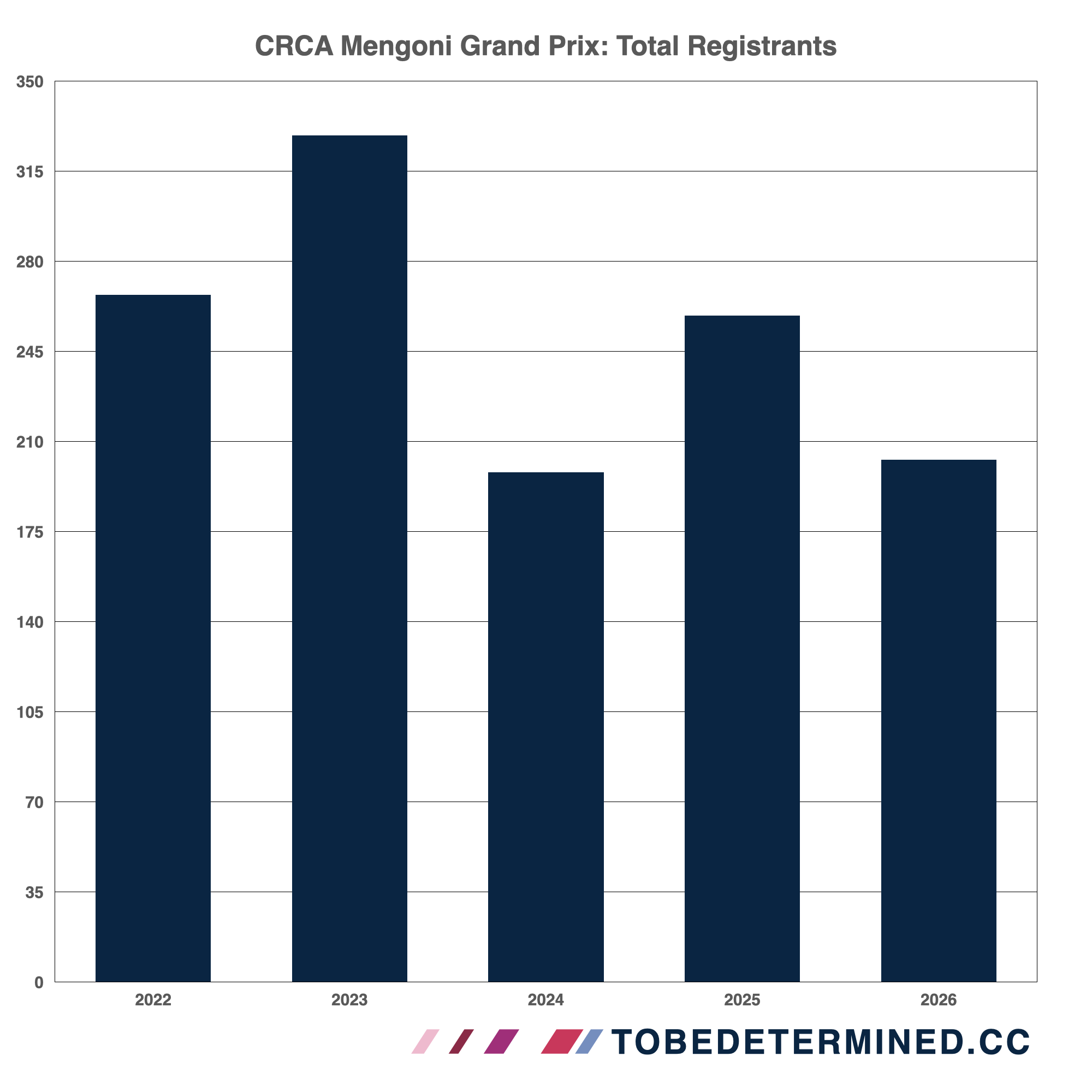
The Mengoni Grand Prix is another race that has featured prominently in the TBD Journal, in part because it was once the most prestigious race in New York City, drawing National Champions and international riders alike. Like so many races, pre- and post-COVID participation trends for the Mengoni look quite different. Yet, as recently as 2023, the race enjoyed sell-out or near sell-out attendance for all Men’s fields.
This risks venturing into sugarcoating territory, but while turnout for this year’s race declined by 20% year-over-year, thankfully this decline for Mengoni is nowhere near as severe as Grant’s Tomb. Later in this post, we’ll look at Prospect Park races as a comparison point for Mengoni’s 203-rider turnout. Big picture—and recognizing that we don’t have insight into underlying event financials—securing 200-plus riders should hopefully leave the Mengoni Grand Prix in a sustainable place moving forward.
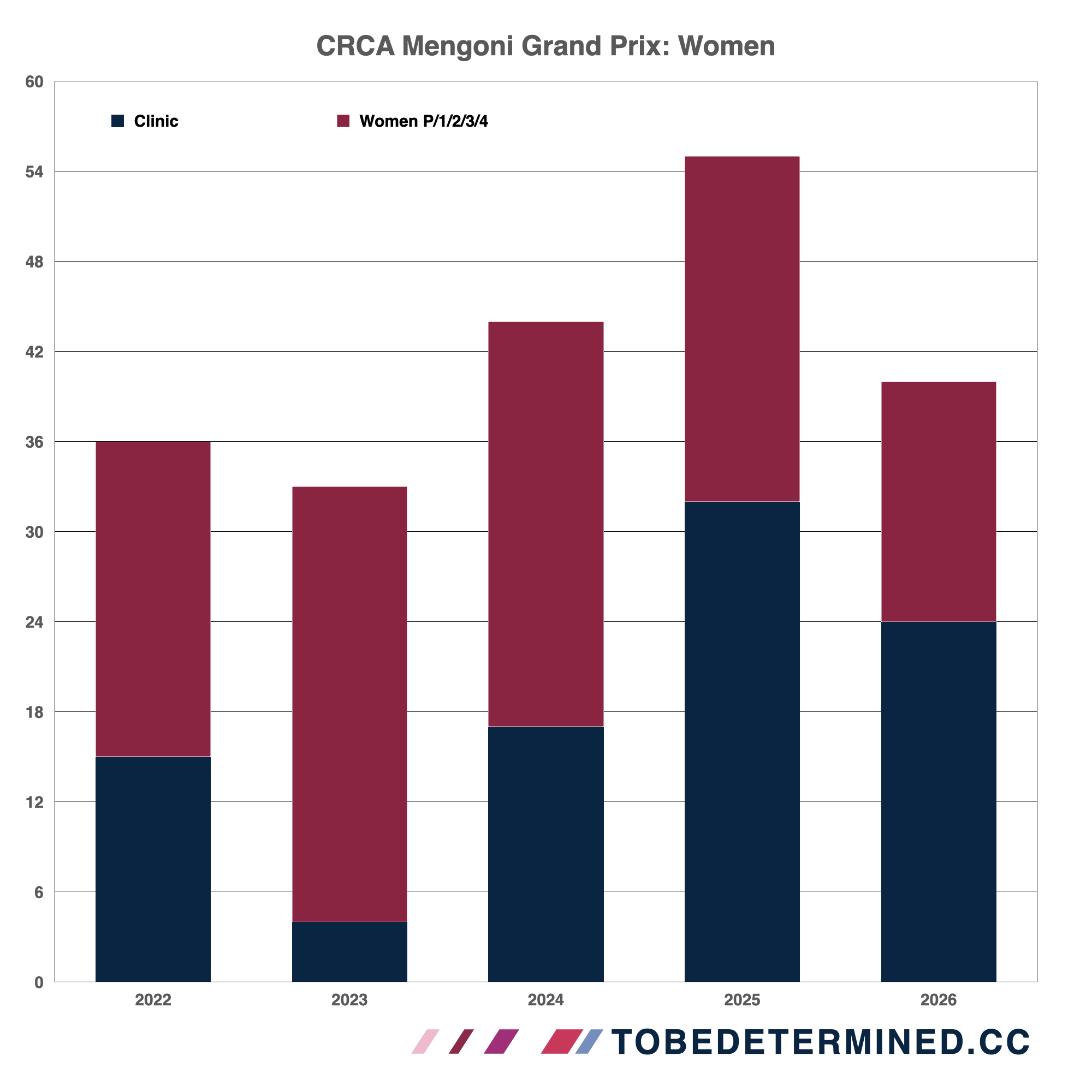
Turning to the Women’s fields at the Mengoni Grand Prix, this year’s 27% attendance decline was slightly worse than the total registration trend. However, the race was coming off a peak year for Women’s participation in 2025, led by huge turnout for the Development Clinic. On a multi-year basis, it’s good to see a slight improvement in turnout compared to 2022 and 2023, though aside from 2025’s blowout year, nothing especially stands out in this data set.
Lucarelli & Castaldi Series in Prospect Park
Racing in Prospect Park, Brooklyn, has admittedly been a blind spot for the State of the Sport. But given this year’s significant structural changes for CRCA, Prospect Park makes for a worthwhile comparison to understand trends outside of Central Park.
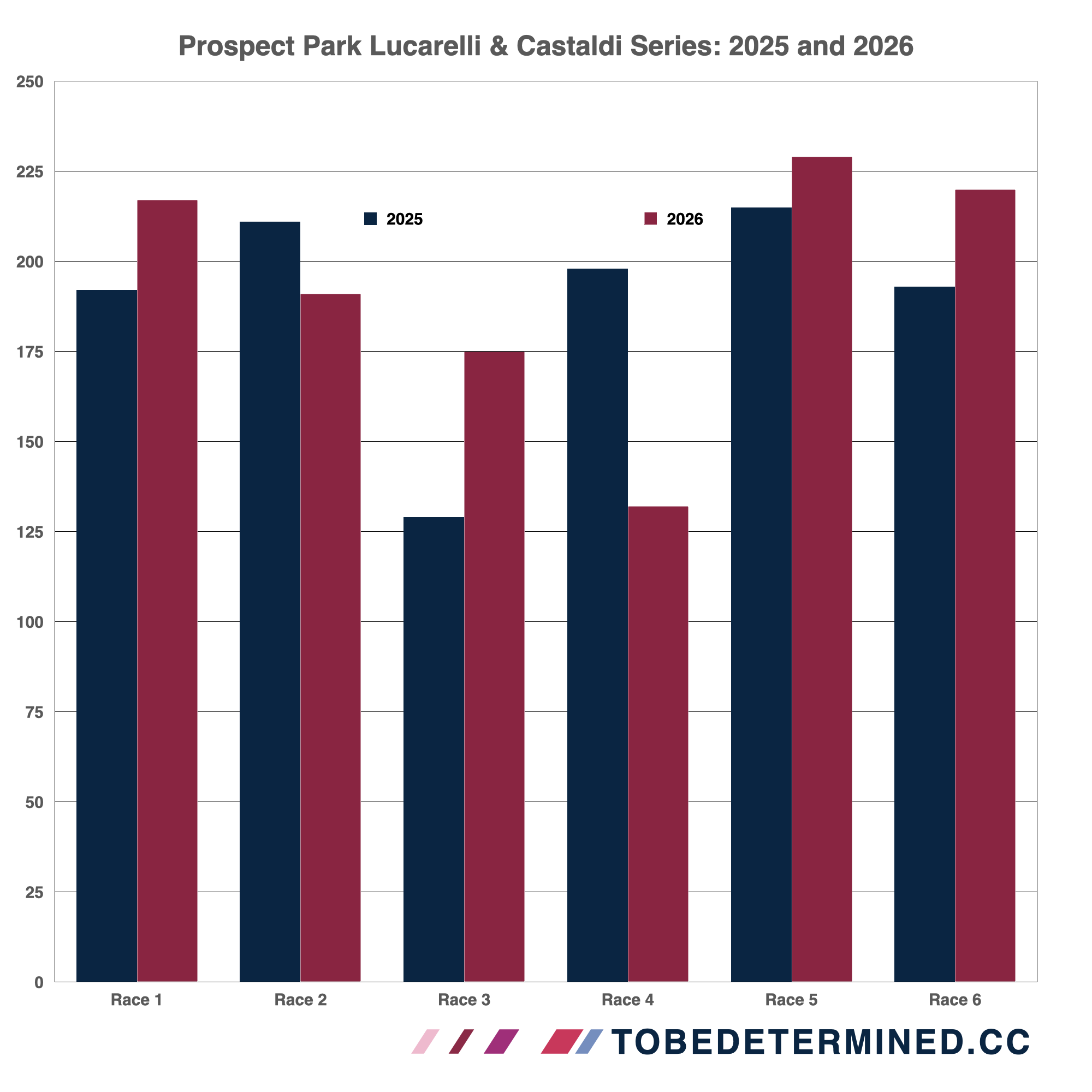
The trends in Brooklyn are frankly encouraging. As always, there is weather-related volatility on individual race days, but looking at the full six races held in the Lucarelli & Castaldi series year-to-date, four featured improved attendance compared to 2025. In total, this amounts to a 2% increase in advanced registration across the 2026 Lucarelli & Castaldi series. It may not be heroic growth, and it is entirely possible that Brooklyn is benefiting from some of CRCA’s declines. But any way you slice it, it is great to see growth in a road racing series against the backdrop of the sport’s broader struggles.
Verge Series in Prospect Park
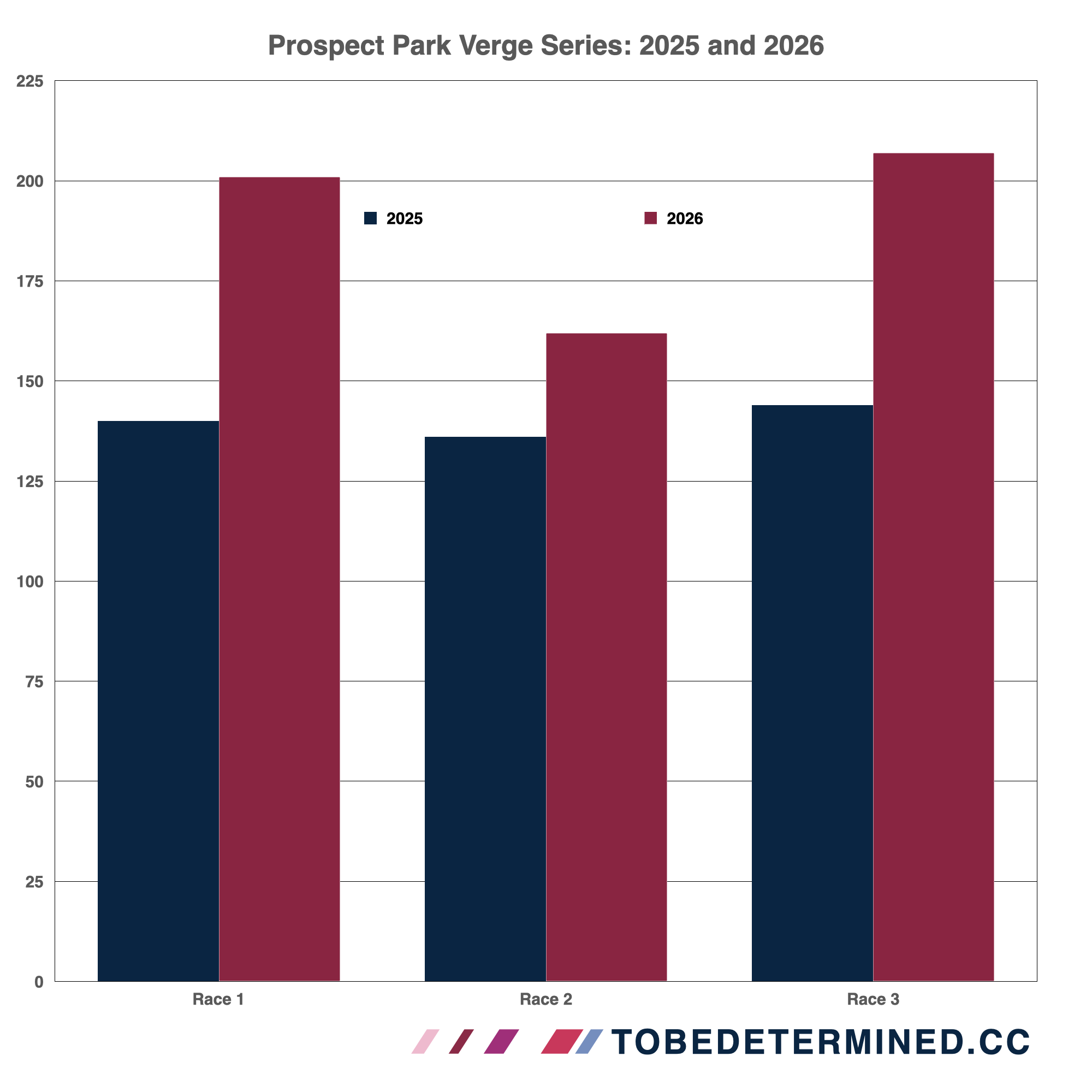
Interestingly, trends are even stronger for the other race series in Prospect Park. While there have only been three races in the Verge Series year-to-date, total series registration is up a massive 36% compared to 2025.
The data do not provide insight into what is driving this growth. It could be anything from more favorable weather to Central Park race days shifting to Brooklyn. The bottom line is that the Verge Series is putting up big attendance growth, something that hopefully continues through the remainder of the season.
One Weekend in NYC Bike Racing
Turning back to Central Park, the State of the Sport hasn’t analyzed the CRCA Club Series because those races don’t use Bikereg.com, our go-to data source for registration analysis. Combined with a shrinking CRCA Open Race calendar that no longer features Fort Lee, Orchard Beach, or Bear Mountain, Bikereg.com data only gives us insight into attendance at a small number of CRCA events. With weather and other factors seemingly impacting this year’s Grant’s Tomb, we are largely left reviewing the Mengoni Grand Prix until we get 2026 data for the upcoming Dave Jordan Central Park Classic.
Given this dynamic, I wanted to add a second data set to this analysis. I turned to my.raceresult.com. Rather than pulling data for the season-to-date Club Series and trying to back-solve for weather and other impacts, I pulled data for the most recent weekend of racing, which featured a Central Park and Prospect Park double header. Saturday was the Lucarelli & Castaldi Series in Brooklyn, while Sunday featured a CRCA Club Series race in Manhattan.
The results data for Prospect Park (in blue) and CRCA (in maroon):
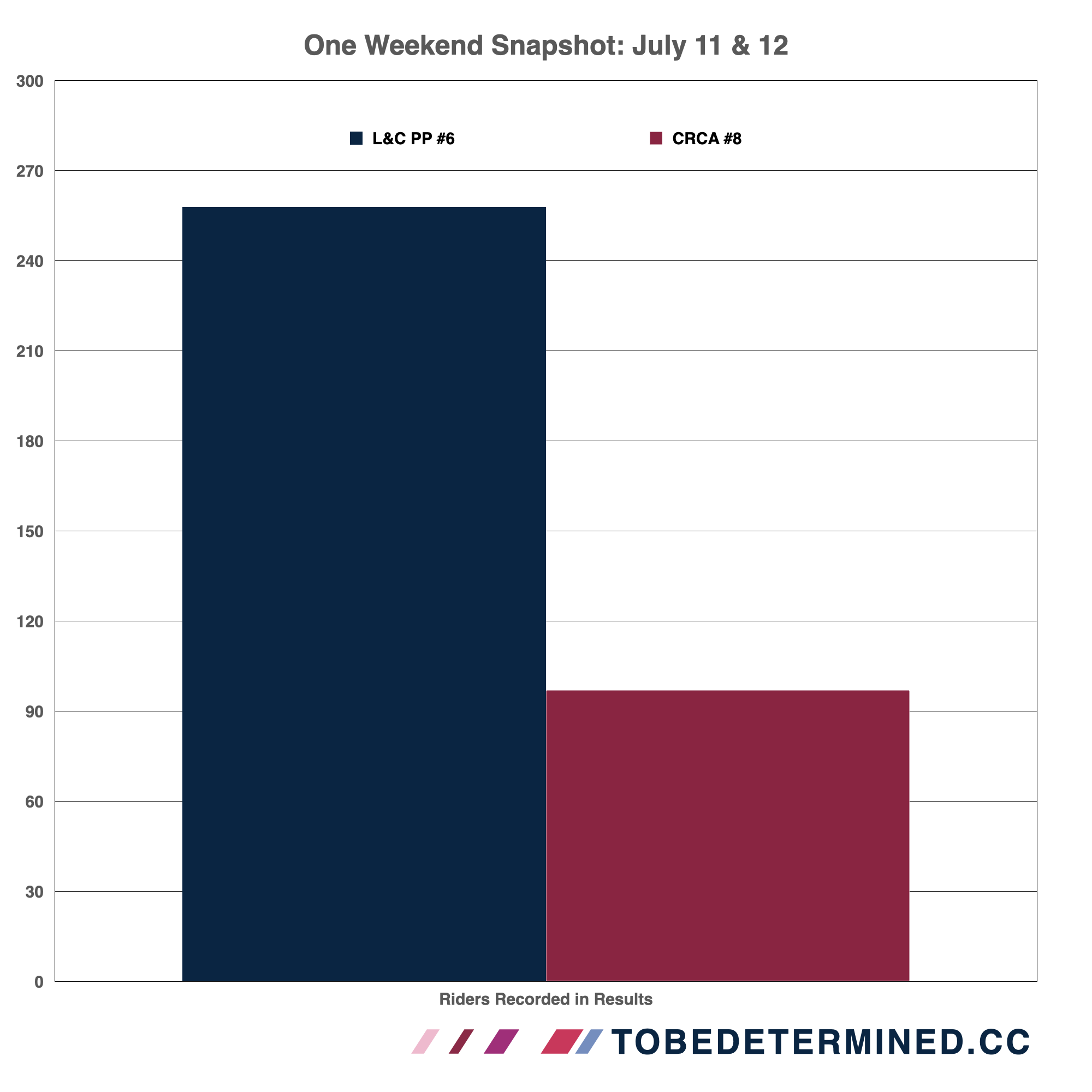
As you can probably guess, there are caveats to this data set. Prospect Park records riders that do not start (DNS) in their results, but CRCA does not. This is possibly due to including all season pass members in the Participant List on my.raceresult.com (presumably a byproduct of how Club race registration works this year). However, the Prospect Park series keeps this registration revenue, and the DNS tallied just 13 riders. Even excluding those riders would not change the disparity: on a weekend with similar weather, Prospect Park had almost 3x the number of racers. Notably, this disparity exists even with one fewer field in Prospect Park compared to Central Park.
Focusing specifically on the Women’s fields, the gap between the two races was much smaller. However, Prospect Park still saw a larger turnout for its single combined (but separately scored) Women’s field compared to the Central Park race’s two separate women’s fields:
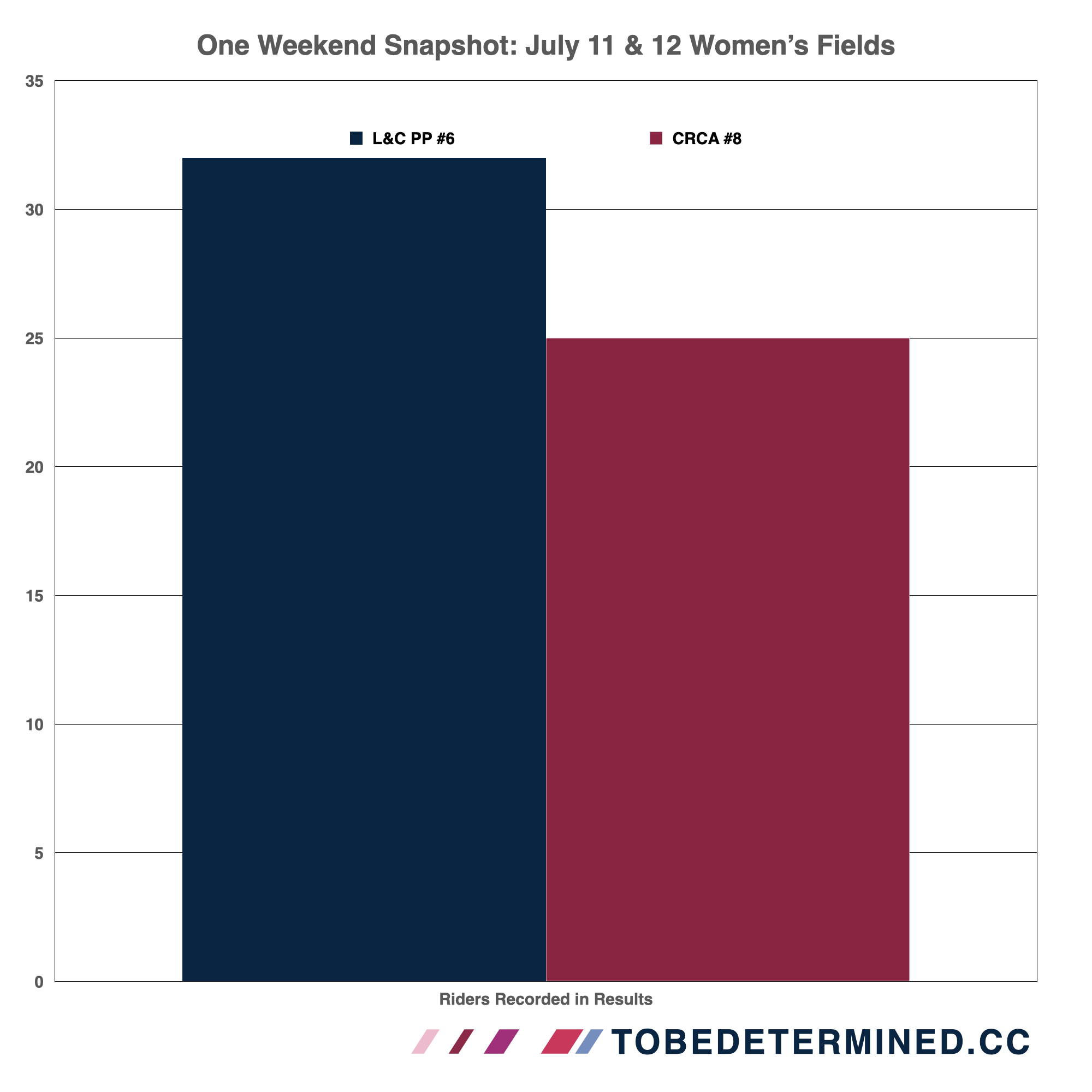
There is a very valid argument that one double-header weekend of racing is a poor sample size. But the disparity is large enough that it gives rise to concerns for the CRCA Club Series. This is especially true given the higher overhead costs in Central Park, which include significantly greater marshaling requirements and five fields racing concurrently versus four fields total, three concurrently, in Prospect Park. Put simply: hosting an event that requires more than 50 marshals, plus motos, officials, and results staff, only to have 97 racers show up is a tough spot to be in.
NYC Bike Racing in 2026: Conclusions
To reiterate, this analysis relies on Bikereg.com confirmed rider lists and my.raceresult.com race results. These data sets have imperfections and ultimately provide no insight into the underlying drivers of participation rates. But races ultimately live or die based on rider turnout, so this analysis provides a vital glimpse into the state of bike racing in NYC.
The Good News: Prospect Park racing turnout is up compared to last year, including particularly impressive growth for the Verge Series. While turnout alone does not inform the underlying profitability of Brooklyn bike races, it suggests these races are in a sustainable place from a participation perspective. Against the backdrop of distress within the broader bike industry, these data points are encouraging.
The Bad News: Unfortunately, the bad is centered on Central Park/Manhattan, where 2026 turnout for several events has been poor. Fewer than 200 advanced registrants for the Grant’s Tomb Crit—a race that surpassed 800 in 2019—is somewhat shocking, even accounting for a poor weather forecast. Registration for the upcoming Dave Jordan Central Park Classic will be informative, but registration for both the Mengoni Grand Prix and the Summer Classic was down year-over-year. Furthermore, the comparison for the most recent weekend NYC double header was stark, with Prospect Park attendance 2.7x larger than CRCA.
I hate writing ‘this is bad’ without offering solutions. But as noted throughout, these data sets are just the output of a multitude of factors, the majority of which are difficult to quantify without extensive rider surveys or other feedback. USAC permitting is undoubtedly a focal point of many discussions, but that cannot be the only driver of very different trends for CRCA and Prospect Park.
Ultimately, CRCA has been around for more than a century. Following the demise of the Spring Series a decade ago, CRCA now holds sole responsibility for sustaining bike racing in Central Park. If this racing in Central Park is going to continue to exist for decades to come, it is vitally important for the Club and the broader cycling community to find a sustainable path forward. What that looks like is a topic for another day.